
Dynamic Organizational Charts
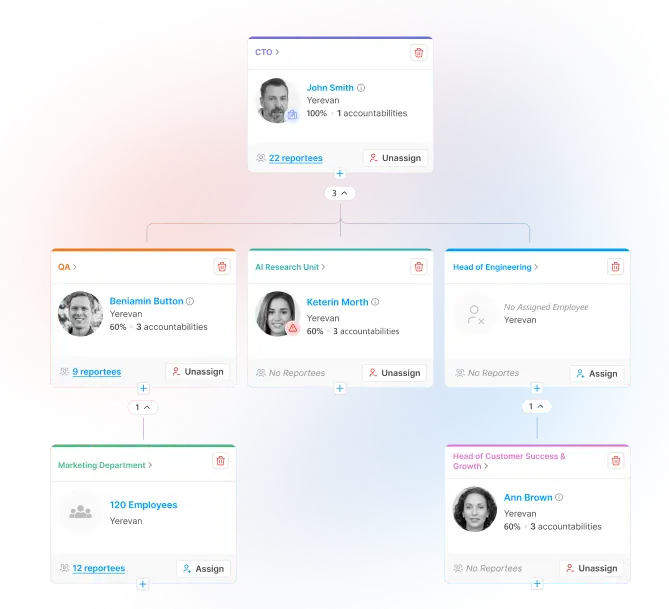
Organizational charts reflect your actual structure, functions, and assignments.

Operational Foundation
Design an HRMS organization structure that makes ownership explicit, accountability visible, and execution predictable.
Request a Demo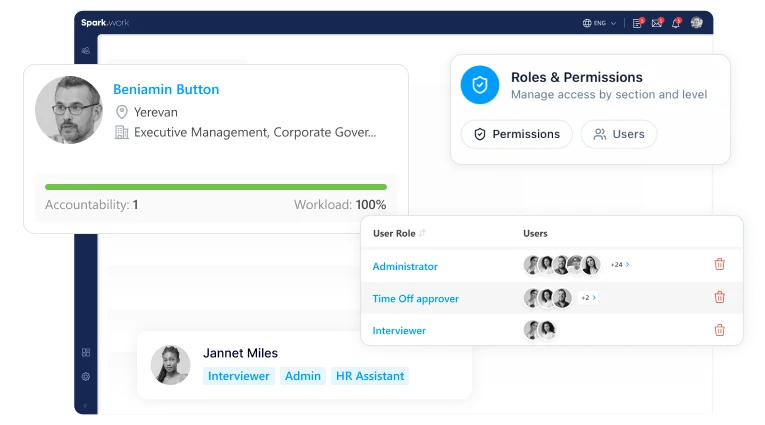
Organizational charts reflect your actual structure, functions, and assignments.
Clear hierarchy views show who reports to whom, which functions exist where, and where accountability sits.
Your organization structure setup moves from documentation to daily execution.
Accountability by Design
A Modern Way to Build Organizational Structure Setup
Start by defining divisions, business units, or branches. Each body becomes a stable container for functions, reporting, and accountability.
Functions are defined with responsibilities, requirements, and documentation. They exist independently of people, keeping the structure stable over time.
Employees are assigned to one or multiple functions, enabling various organizational structures while keeping reporting lines clear.
Set accountabilities after connecting people with functions.
Organizational Governance
Organizational structure that turns responsibility into execution
Accountability is explicit. Functions have clear expectations and owners, not implied responsibility.
A full accountability history shows how ownership evolved over time, removing ambiguity during transitions, audits, or leadership changes.
Time commitment is defined and tracked, exposing under-resourcing and overload early.
Documentation, standards, and learning are attached to the function, not lost with individuals.
When accountability exceeds capacity, leaders see it before outcomes suffer.
Scalable Organizational Design
Spark.work supports hierarchical, divisional, matrix, flat, team-based, and hybrid structures. Your structure evolves without breaking reporting or losing data.
FAQ
It is a function-first organizational model that connects bodies, functions, people, and accountability into one system. Instead of just showing hierarchy, Spark.work defines who owns what, how much capacity they commit, and how work actually gets done.
Traditional organizational charts show reporting lines. Spark.work goes further by linking reporting lines to functions, responsibilities, capacity, and ownership. This turns your organizational chart into an execution-ready operating model, not a static diagram.
Yes. Spark.work automatically generates a real-time organizational chart based on your structure, functions, and assignments. Any change updates instantly, without manual edits or spreadsheets.
Yes. Spark.work supports hierarchical, divisional, matrix, flat, team-based, and hybrid structures. One employee can hold multiple functions while reporting lines and accountability remain clear.
Accountability is defined at the function level and assigned to people explicitly. This means ownership is clear, capacity is visible, and accountability does not disappear when roles or employees change.
Yes. HRMS roles and permissions are based on functions and accountability, not generic titles. Access across recruitment, documents, workflows, and reporting matches real responsibility.
Spark.work is built for change. You can modify bodies, functions, assignments, and reporting lines at any time. Accountability history is preserved, and clarity remains intact during growth, restructuring, or leadership transitions.
Yes. You can configure company calendars, working weeks, custom fields, and localization per body or branch. This supports multi-country operations without breaking reporting clarity.
No. While HR sets up the structure, executives and managers use it to understand ownership, capacity, and execution risk. Employees benefit by knowing exactly what they own and how their work fits.
Yes. Most customers fully replace spreadsheets, slides, and standalone org chart tools with Spark.work's dynamic organizational structure setup.
Initial organizational structure setup usually takes days, not months. Most teams start with their core bodies and functions and refine over time as the organization evolves.